
Want to submit your own news?

Conveyor Belt Tracking Guide
Technical Notes from NIBA's Education Technical Committee
BASIC RULES
- The basic, and primary rule of tracking a conveyor belt is simply "THE BELT MOVES TOWARD THAT END OF THE ROLL IT CONTACTS FIRST."
- The conveyor structure must be "TRUE" (relative to center-line) and LEVEL (side to side).
- All pulleys, snub rollers, carrying idlers, and return idlers must be SQUARE with the frame (perpendicular to belt center-line) and parallel to each other. Check by measuring diagonals - should be equal.
- BELT TENSION must be great enough:
A. To prevent slippage between the drive pulley and the belt, and
B, To force the belt to conform to the crown on the crowned pulleys, if they are used. Belt should not be
over-tensioned. Consult your belt manufacturer. - CLEANLINESS is essential to good belt tracking. Foreign matter in essence creates a new roll or pulley face - adversely affecting tracking.
- The NORMAL SEQUENCE of training is to start with the return run, working toward the tail pulley; following with top run in the direction of belt travel. Start with the belt empty. After tracking is completed, run the belt with a full load and re-check tracking.
- TRACKING ADJUSTMENT is done while the belt is running and should be spread over some length of the conveyor preceding the region of trouble. Permit the belt to run for several minutes and at least three full belt revolutions after idler has been adjusted to determine if additional adjustment is required. If the belt has over-corrected, it should be restored by moving back the same idler, and not be shifting additional idlers or rollers.
- "TRACKING EFFECTIVENESS" of a roll/crown is approximately proportional to the length of the unsupported span of belt approaching the roll up to a maximum of approximately 10'. If there is no such span, tracking effect of the roll is virtually non-existent. However, such a roll can induce camber into the belt as it leaves the roll.
TROUBLESHOOTING "TRACKING"
1. ALL PORTIONS OF CONVEYOR BELT RUNNING TO ONE SIDE AT A GIVEN POINT ON STRUCTURE:
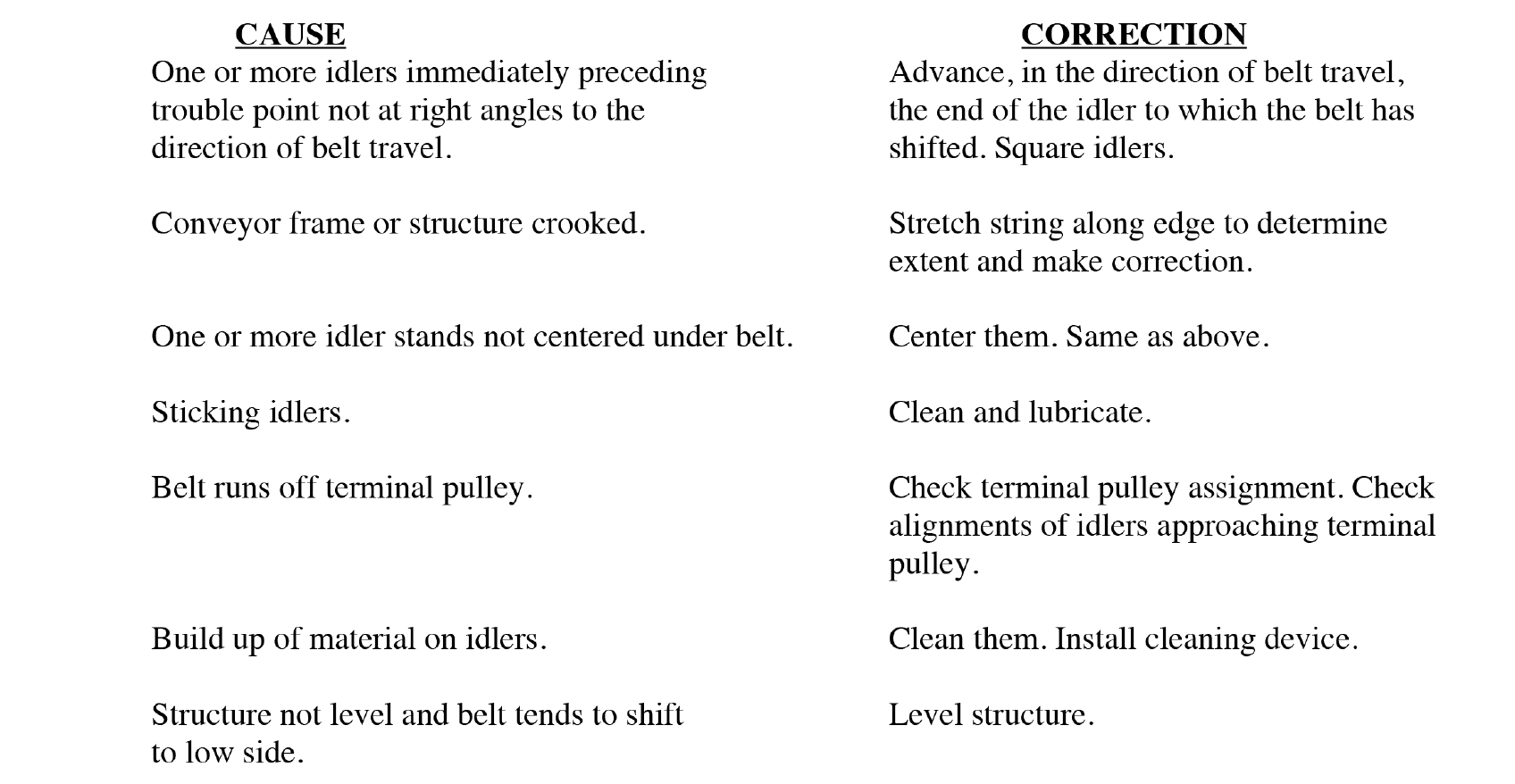
2. PARTICULAR SECTION OF CONVEYOR BELT RUNS TO ONE SIDE AT ALL POINTS ON CONVEYOR

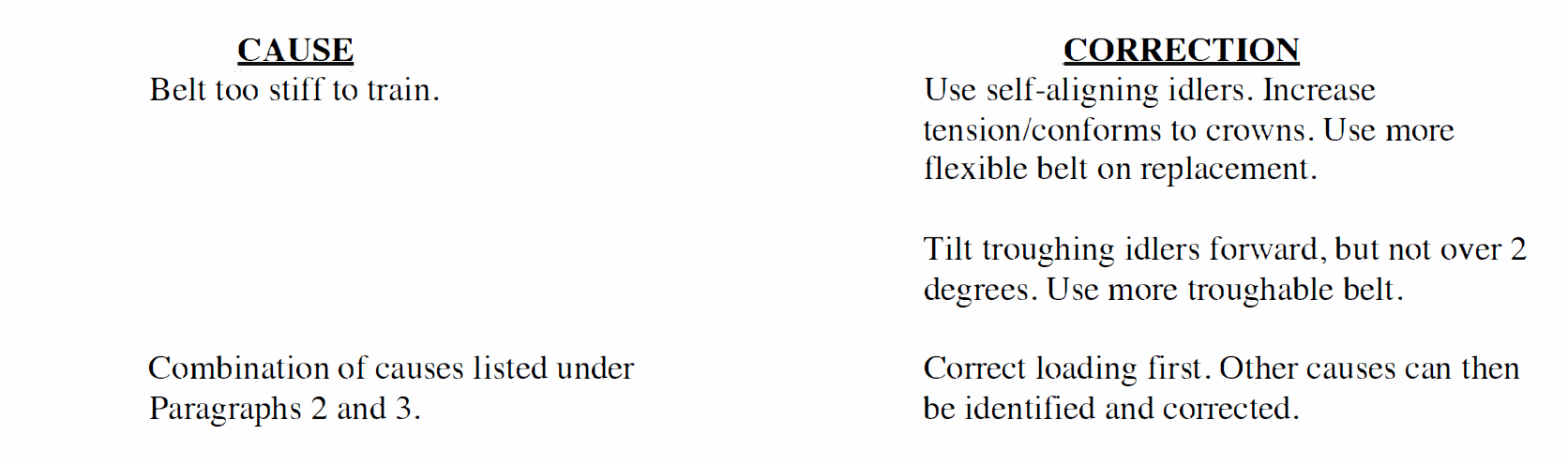
3. CONVEYOR BELT RUNS TO ONE SIDE FOR LONG DISTANCE BED.

4. BELT IS ERRATIC-DOES NOT FOLLOW A PATTERN.
Images
Powered By GrowthZone