
Want to submit your own news?
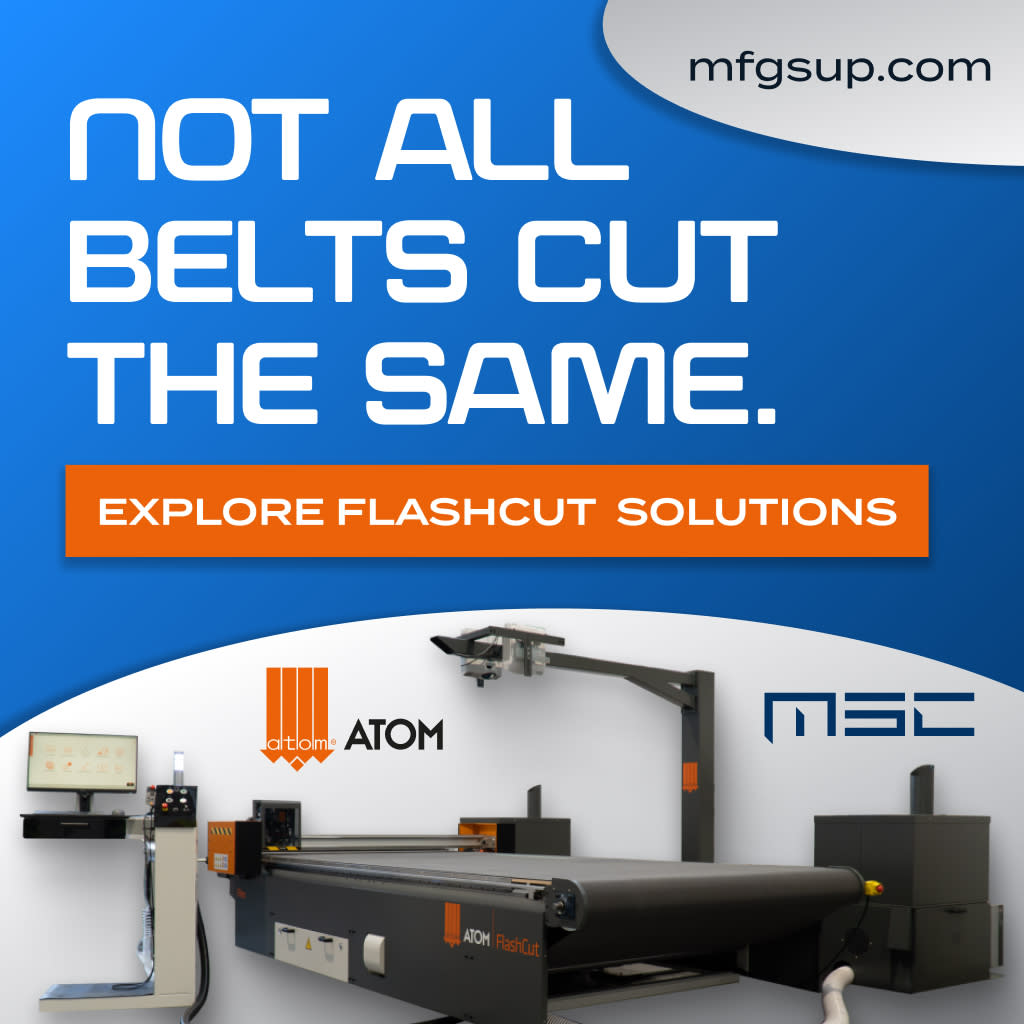
One Belt, Different Cutting Challenges: Rethinking Digital Cutting for Conveyor Belt Fabrication
Why material construction, cutting geometry, and production demands matter when selecting CNC knife cutting technology.
Why Conveyor Belt Cutting Isn’t One-Size-Fits-All
Conveyor belts are engineered for different applications, environments, and performance requirements. That variety creates unique challenges when it comes to fabrication.
A lightweight fabric-reinforced belt, a thicker rubber construction, and a specialty conveyor material may all require different approaches to cutting.
Beyond material composition, fabricators must also consider the shape of the finished component, cutting dimensions, production quantities, and frequency of job changes.
For operations producing custom conveyor belts and fabricated components, the challenge is not simply making a precise cut. It’s selecting a cutting system that can accommodate the range of work moving through the shop.
What Makes a Material Difficult to Cut?
Two materials of identical thickness may respond very differently to the same cutting tool.
A flexible belt may shift during processing, while a reinforced construction may resist the blade or require additional cutting force. Materials with multiple layers can introduce further challenges, particularly when those layers respond differently during cutting.
Several factors influence the cutting approach:
- Material construction: Reinforcement, coatings, and layered structures affect how a cutting tool interacts with the material.
- Thickness and density: These influence blade selection, cutting force, and processing speed.
- Component geometry: Straight cuts, curves, notches, and complex shapes introduce different tooling requirements.
- Material stability: Flexible materials may require additional support to remain positioned during cutting.
For fabricators, evaluating these characteristics before selecting equipment helps determine which cutting technology and configuration are appropriate.
When Production Variety Becomes the Challenge
Many conveyor belt fabricators handle a combination of standard production and custom orders.
One job may require a series of identical components, while the next involves different dimensions, unusual geometries, or a small production quantity.
Traditional die cutting can be highly effective for repeatable production, but dedicated tooling may be less practical when designs change frequently.
Digital CNC knife cutting offers another approach. By using programmable cutting paths, manufacturers can change component geometry without producing a new physical cutting die for each design.
ATOM’s FlashCut technology is designed to support this flexibility, with machine configurations suited to different material sizes, cutting requirements, and production environments.
Choosing the Right Cutting Configuration
The ATOM FlashCut family includes several systems that address different fabrication needs.
The FLEX 2H 4015 S, FLEX PRO 3015 S, FLEX L12 with VRX, SPEEDY 1660 BP, and TWINS 3020 US35 provide a range of equipment options for manufacturers evaluating digital cutting technology.
Rather than selecting a system based solely on cutting area or machine size, fabricators should consider the work they perform most frequently.
A shop processing larger material formats may prioritize cutting area and material support. Operations with changing component designs may place greater emphasis on setup flexibility. Higher-volume environments may need to evaluate how cutting-head configurations, material loading, and operator involvement influence production capacity.
The important distinction is that the right machine is determined by the production application, not simply the number of features available.
A Cutting System Should Be Evaluated by the Work It Needs to Perform
For NIBA members evaluating new technology, a useful exercise is to review several recent production jobs rather than comparing machines using a single demonstration part.
Consider how much of the workload involves repeated shapes, how often materials change, and whether a typical order requires one cutting operation or several.
The five ATOM FlashCut configurations offer an opportunity to explore these differences in practice.
At the MSC Open House, fabricators compared:
| ATOM FlashCut system | What to evaluate |
|---|---|
| FLEX 2H 4015 S | Dual-head production and cutting throughput |
| FLEX PRO 3015 S | Cutting flexibility, setup, and operator workflow |
| FLEX L12 with VRX | Specialized tooling and application requirements |
| SPEEDY 1660 BP | Material positioning and high-speed processing |
| TWINS 3020 US35 | Sequential operations and ultrasonic cutting |
The most informative comparison is not necessarily which machine completes a demonstration fastest. It’s how effectively each configuration handles the type of work a fabricator needs to produce.
Five Questions Worth Asking During a Machine Demonstration
A productive equipment demonstration should answer questions that are difficult to resolve from a specification sheet alone.
- How is the material held in position during cutting?
- What happens when the job changes from straight cuts to complex geometries?
- How much operator involvement is required between cutting cycles?
- Can the system perform multiple operations without repositioning the material?
- How does the equipment handle the actual thickness, reinforcement, and construction of the materials used in production?
For conveyor belt fabricators, these questions can reveal more about equipment suitability than maximum cutting speed alone.
See the Differences in Action
For NIBA members, the event offers an opportunity to compare cutting technologies, discuss specific belting applications, and evaluate equipment configurations with MSC’s technical team.
Understanding how different cutting systems respond to real production requirements can help fabricators make more informed equipment decisions. Talk to an MSC Expert.
https://mfgsup.com/contact-us