
Want to submit your own news?
Multi-Tool Digital Cutting: Meeting the Demands of Advanced Material Processing
As manufacturers work with increasingly complex materials, production requirements continue to evolve. Aerospace composites, engineered foams, technical textiles, honeycomb panels, and high-performance gasket materials all demand precision processing, repeatability, and flexibility. At the same time, manufacturers are under pressure to reduce lead times, minimize waste, and improve overall production efficiency.
To meet these challenges, many converters are turning to advanced CNC digital cutting technologies that combine multiple operations into a single automated workflow.
Why Multi-Process Capability Matters
Many advanced materials require more than a simple cut. A single part may involve through-cutting, kiss-cutting, creasing, marking, punching, or depth-controlled cutting. Traditionally, these processes often require multiple machines, additional setups, or manual handling between operations.
Modern digital cutting systems streamline production by performing multiple processes within a single cutting cycle. This reduces setup time, improves consistency, and helps manufacturers increase throughput while maintaining tight tolerances.
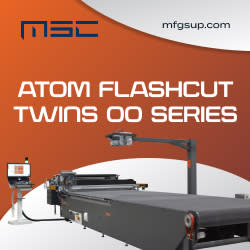
One example is the ATOM FlashCut TWINS OO Series, a CNC digital cutting platform designed to perform multiple operations using a modular tool head with two independent vertical-axis tool positions. This allows different tools to work sequentially on the same part, enabling manufacturers to apply the most effective process for each feature without interrupting production.
Designed for Advanced Materials
The ATOM FlashCut TWINS OO Series was developed with demanding applications in mind, particularly within aerospace, composites, and technical materials manufacturing.
The system can process materials up to 2 inches (50 mm) thick and supports a wide range of applications including:
- Composite laminates
- Carbon fiber and pre-preg materials
- Aramid fibers (Kevlar®)
- Fiberglass fabrics
- Honeycomb panels
- Technical foams
- Gasket materials
- Industrial textiles
By utilizing specialized tooling, manufacturers can achieve cleaner cuts, improved edge quality, and greater process control across a variety of substrates.
Specialized Tooling for Challenging Materials
As advanced materials continue to gain adoption, cutting technology must evolve alongside them.
The FlashCut TWINS platform offers dedicated tooling options including:
- Ultrasonic cutting technology for precise cutting of pre-preg materials and multi-ply composite stacks
- PRC cutting tools designed for aramid fibers, dry textiles, and glass fiber materials
- Specialized tools for processing foam and honeycomb structures
- High-speed kiss-cutting and depth-controlled cutting capabilities
The ultrasonic cutting system is particularly valuable for converters seeking exceptional edge quality while reducing fraying and material distortion. The technology allows manufacturers to process multi-layer materials with remarkable precision, making it ideal for both production and prototyping environments.
Beyond Cutting: Integrated Automation
Today's manufacturers require more than just cutting performance. Traceability, quality control, and workflow efficiency have become equally important.
The FlashCut TWINS Series can integrate:
- Camera-based registration systems
- Automatic fiducial recognition
- High-resolution inkjet part marking
- Edge-hardening systems for easier part handling
- Digital production workflows
These features help reduce manual intervention while improving consistency and repeatability throughout the production process.
A Flexible Solution for Modern Manufacturing
One of the greatest advantages of digital cutting technology is its ability to adapt quickly to changing production requirements. Whether producing prototypes, short runs, or full-scale production volumes, manufacturers can move from one job to the next without tooling changes or lengthy setup times.
For converters processing a wide variety of materials and applications, this flexibility can significantly improve responsiveness while reducing operational costs.
As advanced materials continue to shape industries such as aerospace, defense, transportation, and industrial manufacturing, technologies like the ATOM FlashCut TWINS OO Series are helping manufacturers improve productivity, maintain quality, and confidently tackle increasingly complex applications.
The future of material processing isn't simply about cutting faster. It's about integrating multiple processes, maximizing flexibility, and creating smarter production workflows that deliver consistent results.
To learn more, visit https://mfgsup.com/knife-cutting/atom-flashcut-twins-series/twins-series